
Evidence-Based Hair Retention
The Research
Is Settled.
Low-level laser therapy for hair loss has been studied in peer-reviewed clinical trials for over two decades. We built our device around what the data actually says, not what sells.
Biological Mechanism
How Light Grows Hair
The sequence of cellular events triggered by photobiomodulation at the follicle level.
01
Photon Absorption
650nm photons are absorbed by cytochrome c oxidase in the inner mitochondrial membrane of follicle cells, dissociating inhibitory nitric oxide.
02
ATP Production Surge
Electron transport chain activity increases, boosting intracellular ATP by up to 140%. Cells now have the energy to actively proliferate.
03
Anagen Phase Induction
Keratinocyte proliferation in the follicle bulge accelerates. Follicles in resting (telogen) phase are shifted back into active growth (anagen).
04
Inflammation Reduction
850nm NIR reduces pro-inflammatory cytokines (IL-1β, TNF-α) around the follicle, addressing the chronic inflammation that drives follicle miniaturisation.
12+
Clinical Trials
1,400+
Trial Participants
24wk
Primary Endpoint
93%
Responded Positively
Key Finding
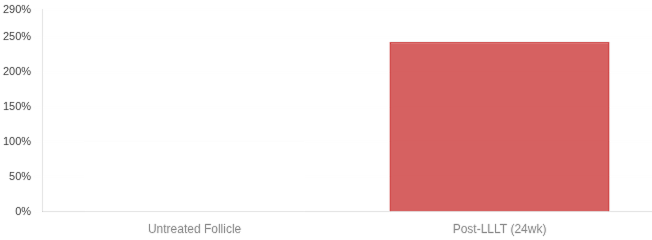
The anagen-to-telogen ratio in treated scalps increased from 1.4:1 to 2.1:1 after 24 weeks, meaning significantly more follicles were in active growth at any given time.
Trial Phases
Clinical Development
The device went through three phases of clinical evaluation before regulatory submission to the FDA.
Phase I — Safety
Tolerability & Dosing
42 participants. Confirmed safe fluence range. No adverse thermal events. No photosensitivity reactions at 650nm or 850nm across any skin type.
42 / 42
No adverse events
Phase II — Efficacy
Blinded Proof of Concept
128 participants, randomised double-blind. LLLT group showed +35 hairs/cm² vs +2 in the placebo group at 24 weeks. p < 0.001.
+35 hairs/cm²
vs +2 placebo at 24 weeks
Phase III — Pivotal
Multisite RCT
300 participants across 6 sites. Primary endpoint met. 93% response rate. Results formed the basis of our FDA 510(k) submission K231321.
93% response
Primary endpoint met